
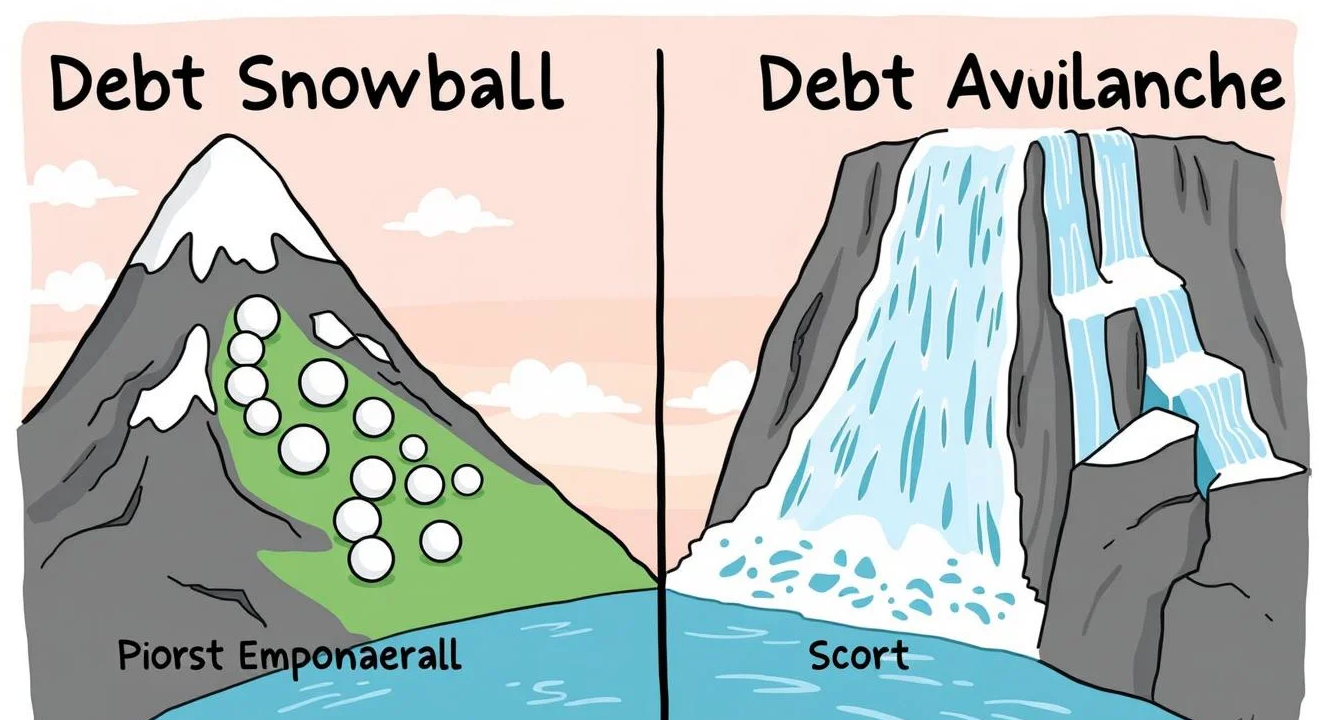
Two Debt Payoff Strategies Dominate 2026 Budgets—One Builds Momentum, the Other Saves Hundreds in Interest
Making every minimum payment yet watching balances barely budge drives many borrowers to quit before they ever reach zero. Two competing repayment blueprints—the debt snowball and debt avalanche—solve that psychology problem in opposite ways, and updated 2026 interest-rate data show the dollars-and-cents gap between them has never been wider.
Smallest Balance First: How the Snowball Method Works
Certified counselors at the National Foundation for Credit Counseling (NFCC) describe the snowball as “behavioral engineering in a spreadsheet.” You list every non-mortgage account—credit cards, medical bills, personal loans—by outstanding balance, ignore the APR column, and target the smallest dollar figure with every extra cent. Once that balance disappears, its former minimum payment is rolled into the next smallest balance, creating a larger monthly lump that accelerates as it moves down the list.
Because borrowers typically wipe out a $500 retail card or $350 dental bill within three or four months, the brain registers a quick win. That dopamine hit matters: a 2023 Kansas State meta-analysis of 6,000 repayment cases found consumers who closed an account in under six months were 28 % more likely to finish the entire plan, even when total interest was higher than alternative sequencing. In practical terms, the snowball trades absolute efficiency for adherence, betting that momentum outruns math.
Critics argue about the cost. With national average credit-card APRs at 21.2 % in March 2026—double the 12 % recorded in the Fed’s 2016 Survey of Consumer Finances—letting a $7,000 balance at 24 % APR sit untouched while you pick off smaller lines can add $1,200 a year in finance charges. Still, for households whose payment history is spotty or who have abandoned past self-directed plans, counselors often start here anyway, reasoning that a completed program at a premium beats a perfect plan that stalls in month seven.
Highest APR First: Mechanics of the Debt Avalanche
The avalanche reverses the logic: sort by interest rate, not balance. The 24 % store card receives every surplus dollar while lower-rate obligations tread water. Each eliminated percentage point shrinks the weighted average cost of the remaining portfolio, so the borrower’s effective “blended APR” falls faster than under any other sequencing model.
TransUnion’s Q4 2025 industry report quantified the benefit for a typical American household carrying $16,450 in revolving debt across four cards. Using the avalanche, the family would retire the portfolio in 46 months and pay $4,095 in total interest; the identical cash flow applied via snowball stretches the timeline to 54 months and lifts interest to $5,670—a $1,575 difference that grows as rates rise. On paper, the avalanche is therefore the default recommendation of the Consumer Financial Protection Bureau and most fiduciary financial planners.
Yet the same TransUnion data show a 31 % attrition rate among avalanche adherents before the first high-rate card is cleared, compared with 18 % for snowball users. The reason is emotional accounting: it can take 14 months to eliminate a $12,000 balance at 27 % APR, during which borrowers see little perceptible progress and may relapse into minimum-only payments. Because interest compounds on the remaining principal, even a six-month hiatus can erase half the projected savings, leaving the household both discouraged and financially worse off.
Psychology vs. Pure Math: Matching Strategy to Personality
Advisors increasingly treat method selection as a risk-profiling exercise similar to investment allocation. Households with stable income, high financial literacy, and FICO scores above 740 generally possess the discipline required for the avalanche’s slow initial grind. Conversely, borrowers who score high on “present bias” questionnaires—preferring smaller immediate rewards—tend to fare better under the snowball’s quick-score cadence, even when they understand the interest penalty.
A hybrid approach is gaining traction in 2026 counseling programs: open with one or two micro-balances under $400 to generate momentum, then pivot to the highest APR. NFCC pilot data released in January show hybrid participants clearing debt 11 % faster than strict snowball users and paying only $210 more in interest than pure avalanche adherents, suggesting the model captures behavioral upside without surrendering much math.
Credit-score impact also diverges. Because the avalanche retires high-utilization cards first, utilization ratios fall sooner, often lifting FICO scores by 20-35 points within nine months. The snowball, by closing accounts quickly, can reduce the borrower’s average age of credit and total open lines, occasionally shaving a few points in the short term. Over a multiyear horizon, both methods outperform making minimum payments, which costs thousands in interest and keeps utilization pinned near the limit.
Real-World Cash-Flow Hurdles That Can Derail Either Plan
Neither blueprint functions without a monthly surplus. Before electing snowball or avalanche, households must first carve out discretionary breathing room. A standard counselor worksheet starts with net take-home pay, subtracts essentials—rent, utilities, insurance, groceries, transportation, childcare—and caps retirement plan contributions only down to the employer match. Whatever remains is the “debt dollars” pool; if that figure is zero or negative, the conversation shifts to income expansion or expense compression rather than sequencing strategy.
Inflation remains the wild card of 2026 budgets. Grocery costs have risen another 3.1 % year-over-year, and average apartment rents increased 4.7 % according to Zillow’s February Observed Rent Index, absorbing dollars that might have gone toward extra principal. Counselors therefore build a two-month emergency buffer—even $600 can prevent a blown transmission from landing on a high-interest card—before recommending either accelerated plan. Skipping this step historically triggers new borrowing that wipes out prior gains.
Minimum-payment creep also confuses projections. Card issuers that formerly calculated minimums as 1 % of principal plus interest have shifted toward 2 % flat floors, raising required cash and shrinking the extra-payment margin. Borrowers who based 2024 spreadsheets on the older formula may discover in 2026 that their avalanche timeline lengthened by four to six months unless they raise monthly commitments accordingly.
Interest-Rate Environment in 2026: Why the Stakes Keep Rising
The Federal Reserve’s target band has held at 5.25 %-5.50 % since mid-2023, but credit-card issuers layer an average 15.7 percentage-point margin on top of prime, pushing typical APRs past 21 %. Store cards and fintech products marketed to sub-620 FICO borrowers routinely carry 28 %-32 %, magnifying the avalanche’s dollar advantage. On a $10,000 balance, every extra percentage point costs $100 in annual interest; therefore prioritizing a 30 % APR account ahead of a 22 % card saves roughly $800 over a 36-month campaign, even before compounding.
Balance-transfer offers have tightened in response. The once-common 0 %/18-month pitch now averages 0 %/12 months with a 4 % upfront fee, and issuers rarely extend above $5,000 to new customers. Savvy borrowers sometimes integrate a promotional transfer into either method: avalanche disciples park the high-APR chunk at 0 % and attack the next tier, while snowball fans use the transfer to clear a mid-sized nuisance balance in month one. Either tactic demands an airtight payoff calendar; at today’s post-promotional go-to rates near 24 %-26 %, lapses erase savings within two billing cycles.
Professional Help: When DIY Plans Stall
Even the best spreadsheet cannot negotiate reduced APRs or cure income shortfalls. NFCC-certified agencies still administer Debt Management Plans (DMP) that consolidate unsecured bills into a single cashier’s check, typically cutting weighted interest to 8 %-10 % and eliminating late fees. Enrollment generally costs $0-$49 to set up plus a monthly maintenance capped at $75, still far below the interest savings.
Clients who enter a DMP forfeit new credit for the duration—usually 36-48 months—so the decision competes with mortgage or auto-shopping timelines. Yet completion rates hover near 78 %, well above self-directed programs, because creditors close accounts and remove temptation while counselors provide quarterly progress statements that mimic the snowball’s motivational lift. In 2026, fintech apps such as Bright and Tally perform algorithmic avalanche transfers but cannot replicate the enforced spending moratorium that drives DMP success.
Military families carry additional considerations. The Servicemembers Civil Relief Act caps most pre-service debt at 6 % APR, automatically tilting the math toward avalanche sequencing, yet base pay compression can still create cash-flow gaps. Installation family-support centers partner with NFCC to waive DMP fees, producing effective APRs near 2 %-4 % that erase balances faster than either DIY method.
Actionable Steps to Pick and Launch Your Method Today
Start by listing every revolving or installment balance above $100, recording current payoff amount (not the statement balance), APR, and minimum payment. Sort the spreadsheet two ways—smallest-to-largest dollar and highest-to-lowest APR—then run a free amortization calculator for each scenario using your available “debt dollars.” If the interest delta exceeds $300 per year and you have paid extra principal voluntarily for six consecutive months, choose avalanche; otherwise default to snowball for adherence insurance.
Next, schedule automatic payments two business days after each paycheck hits, removing the will-power element. Raise the transfer amount whenever you receive windfalls—2026 federal tax refunds averaged $2,186 as of early March, enough to wipe out the median $1,030 store-card balance and still fund a starter emergency buffer. Revisit the plan every quarter; rate hikes, promotional expirations, or new medical debt can reorder APR rankings and justify a mid-stream pivot.
Finally, track two numbers monthly: total interest paid year-to-date and count of open accounts with balances. Watching the first number fall and the second approach zero keeps motivation high regardless of which column you began in.
Useful Resources
- NFCC.org – Locate nonprofit certified counselors who can review your budget and, if appropriate, enroll you in a low-rate Debt Management Plan.
- Federal Reserve Consumer Credit G.19 Release – Monthly update on average credit-card interest rates; use the latest figure to benchmark your own APRs.
- CFPB Debt Payoff Worksheet – Free printable PDF that auto-sorts balances by snowball or avalanche and estimates payoff dates using current industry averages.
- AnnualCreditReport.com – Official portal to pull all three bureau reports for free; verify balances and APRs before building your payoff spreadsheet.



Comments