

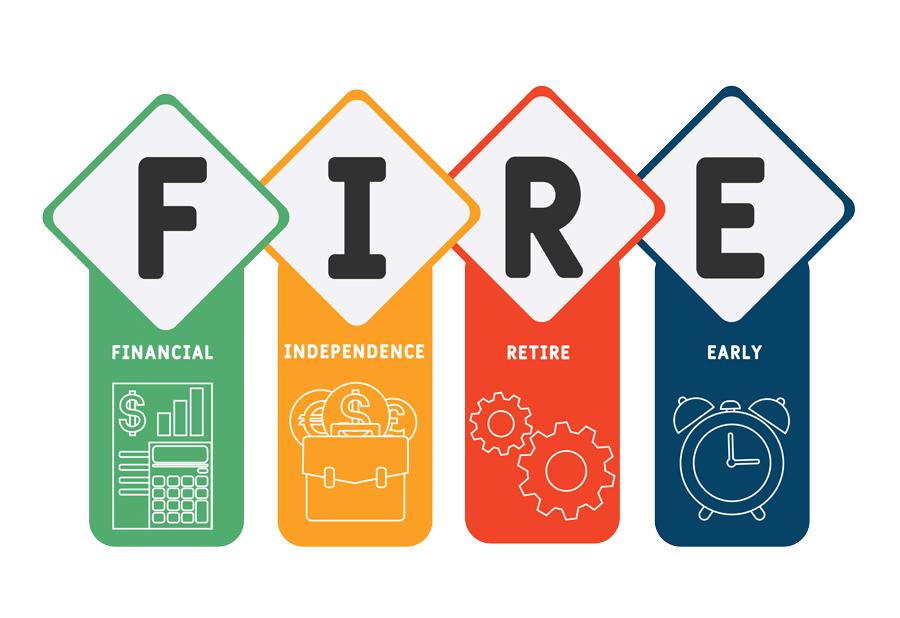
Fire followers are rewriting the retirement timeline, aiming to clock out permanently while peers are still climbing the corporate ladder. The Financial Independence, Retire Early (FIRE) movement now counts millions of online participants who swap spreadsheets, brokerage screenshots, and grocery hacks in pursuit of decades of paid leisure.
Traditional FIRE Formula Relies on 25-Expense Rule
The math is brutally simple: estimate every dollar you will spend in a year of freedom, multiply by twenty-five, and the product becomes your target portfolio. The rule springs from the 4 % withdrawal guideline popularized by Trinity College researchers in the late-1990s; historically, a 60/40 U.S. stock-bond mix survived thirty-year retirements when no more than 4 % of the opening balance was tapped annually. Devotees, therefore, treat the market like a cash machine that spits out 1/25 of its value each year without eating the principal. A household comfortable on $40 000 annually needs roughly $1 million invested, a figure many reach by saving 50-70 % of after-tax income for ten to twelve years, often beginning in their mid-twenties. Critics warn that sequence-of-returns risk, inflation spikes, or a decade of sub-par growth could shred the plan, yet forums overflow with net-worth charts that cross the magic threshold before the saver’s fortieth birthday. In Raleigh, North Carolina, for instance, a 38-year-old municipal planner posted a screenshot showing her taxable account balance at $1.02 million—built on a $72 000 salary—triggering 2 400 congratulatory up-votes and a wave of “I’m next” replies.
Lean FIRE Pushes Spending to Poverty-Line Levels
Lean FIRE adherents budget for expenses at or below the federal poverty line—about $14 000 for an individual in 2026—so a $350 000 brokerage account can, in theory, cover basics forever. Practitioners relocate to low-cost Midwest towns, practice “dumpster-diving capitalism” by reclaiming curbside furniture, and swap smartphones for library Wi-Fi. The upside: financial independence arrives faster; the downside: one blown transmission or root canal can erase years of rice-and-beans discipline. Even supporters concede the lifestyle resembles voluntary austerity more than middle-class comfort, yet Reddit’s r/leanfire community has quadrupled since 2020 as inflation pushed traditional targets further out of reach. Unexpectedly, several posts brag about annual dental vacations to Mexico, where cleanings cost $30 and the airfare is paid with credit-card points—proof, they claim, that lean does not have to mean grim.
Fat FIRE Targets Luxury Budgets Above $200 000 a Year
At the opposite extreme, Fat FIRE savers refuse to downgrade champagne tastes. They shoot for portfolios north of $5 million so that $200 000–$300 000 can flow annually without imperiling capital. Tech workers, specialist physicians, and dual-income corporate couples dominate this niche, banking six-figure bonuses and pouring them into index funds, rental apartments, and deferred-compensation plans. Because the required savings rate still hovers around 40 % of gross income, members keep the high-stress jobs they eventually hope to escape, creating a paradox: the more luxurious the imagined retirement, the longer the corporate grind endures. Wealth managers caution that fat budgets inflate faster than CPI; healthcare concierge services, second-home HOA dues, and private-college gifts for grandchildren can double projected spending within five years. Critics argue that the move raises questions about whether the label “retirement” still fits when annual outflows rival many households’ lifetime earnings.
Barista FIRE Mixes Part-Time Work With Portfolio Withdrawals
Barista FIRE rejects the binary choice between fifty-hour weeks and full-time leisure. Followers build a $250 000–$600 000 cushion, then switch to low-burn, low-stress employment—Starbucks for health insurance, freelance copy-editing for ski passes, seasonal National Park gigs for campground housing. The portfolio covers half of living costs while paychecks handle the rest, allowing earlier escape from corporate life without betting everything on market returns. Demographically, this flavor attracts parents who want school-day schedules and burned-out millennials craving meaning over maximum income. Employer-provided healthcare remains the linchpin; several early adopters postponed exit plans in 2024 when marketplace premiums jumped 9 % nationally. Meanwhile, the phrase “Barista FIRE” itself has become a rallying cry on TikTok, where baristas-in-fact post day-in-the-life clips tagged #ExitVelocity, latte art foam framing the latest dividend deposit.
Cashflow FI Replaces Salary With Rental and Digital Income
Jannese Torres, a Latina money educator, popularized Cashflow FI after calculating that her FIRE number would exceed $2.5 million—an unreachable summit on her nonprofit salary. Instead, she acquired two duplexes, launched a podcast monetized through affiliate links, and self-published curriculum worksheets for teachers; combined cash flow now covers 105 % of last year’s W-2 earnings. The model treats dividends, royalties, ad revenue, and rent as interchangeable salary proxies, so “retirement” happens once passive streams equal monthly expenses, regardless of portfolio size. Proponents warn that rental vacancies or YouTube algorithm changes can slash income overnight, yet the strategy’s flexibility—each new stream moves the finish line closer—continues to draw creators, gig economists, and immigrants who distrust stock-based wealth. Separately, Facebook groups dedicated to “Airbnb arbitrage” have doubled in membership since 2023, suggesting that Cashflow FI is morphing faster than textbooks can track.
Coast FIRE Lets Compound Growth Finish the Race
Coast FIRE practitioners front-load retirement accounts in their twenties, then stop contributions entirely and let compulsion-like compounding finish the job. A 25-year-old who salts away $175 000 by age 30, invested in 90 % equities, theoretically crosses the traditional threshold near 60 without adding another dime, assuming 7 % real returns. The appeal lies in reclaimed cash flow: once the “coast” number is hit, every future paycheck can fund travel, entrepreneurship, or part-time parenting without sabotaging old-age security. Skeptics note that a prolonged bear market early in the coast phase can derail projections, forcing mid-life catch-up contributions that feel more punishing than steady saving would have been. Still, Google search volume for “Coast FIRE calculator” spiked 320 % last year, indicating that many young workers prefer the wager on time rather than on perpetual belt-tightening.
Action Steps
- Calculate your annual living costs under three scenarios—basic, comfortable, and luxury—to see which FIRE flavor fits.
- Open a brokerage account designated strictly for long-term index funds; automate transfers the day after each payday.
- Track every expense for ninety days; leaks like unused subscriptions or convenience fees often fund an extra 5 % savings rate.
- Map one side-hustle that could generate $500 monthly within six months—tutoring, Etsy templates, or vending-machine routes all count.
- Revisit your withdrawal plan annually; adjust for inflation, health shocks, and lifestyle creep before handing in the resignation letter.
Sources: Trinity College study, Reddit r/leanfire, Google Trends, Bureau of Labor Statistics


Comments