
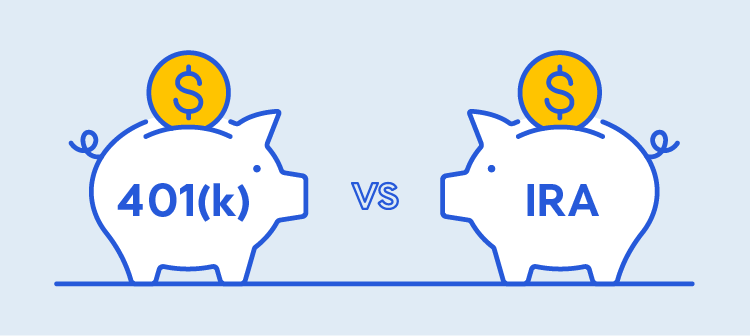
401(k) vs IRA: Employer Plan or Individual Account—Which Builds a Bigger Nest Egg?
401(k)s and IRAs both shelter retirement dollars from annual taxation, yet the paths they offer—and the guardrails they impose—diverge sharply once you move past the headline that both are “tax-advantaged.” One hinges on where you work; the other hinges on the fact that you work at all. The choice you make, or the order in which you use them, can shift your lifetime balance by six figures once compounding, employer cash, and tax drag are tallied over thirty years.
How 401(k) Access Depends on Your Employer
A 401(k) is not an account you open; it is an account you are allowed to enter. Only an operating business—corporation, partnership, non-profit, or government unit—can sponsor the plan, and federal law lets the sponsor impose age, service, and even hours-worked gates. Roughly 68 percent of private-sector employees had access to a plan in 2023, according to the Bureau of Labor Statistics, yet coverage falls to 51 percent for firms with fewer than 100 workers. Gig platforms, independent-contractor relationships, and most S-corporation owners who pay themselves only dividends are effectively walled out unless they create a solo 401(k), a step few take because of setup cost and annual filing once assets top $250,000.
Once you clear the eligibility gate, the plan’s architecture is rigid: payroll deduction only, automatic withholding of Social Security and Medicare on the gross, and a custodian chosen by a committee of executives who must meet ERISA fiduciary standards. You cannot shop for lower fund fees or bolt on a brokerage window unless the plan adds one. In practical terms, your first indication of what is inside is the glossy enrollment kit that lands on your desk—or, increasingly, the push notification from the HR app that nudges you to “adjust your deferral rate” before the open-enrollment window closes.
In Midland, Texas, for instance, a 28-year-old rig mechanic who finally qualifies after 12 months of 30-hour weeks told MarketWatch he was startled to find only seven funds on offer, none cheaper than 0.65 percent. “I thought I’d see the whole market,” he said. “Turns out I just see the menu they agreed on.”
IRA Eligibility Rules and Income Phase-Out Thresholds
An IRA, by contrast, is retail. Any provider that files the 5305 form with the IRS—Fidelity, Charles Schwab, a local bank, even a robo-advisor—can open the account in under ten minutes as long as you (or your spouse) document earned income on your jointly filed 1040. The hurdle is not access; it is the silent fade-out of tax perks once modified adjusted gross income crosses statutory cliffs. For 2026, the Roth IRA contribution window shuts entirely at $165,000 for single filers and $246,000 for joint filers, numbers that rise modestly each October when the IRS releases inflation adjustments. Traditional IRA deductibility is even murkier: if both spouses participate in workplace plans, the deduction phases out between $118,000 and $138,000 joint MAGI, creating a “now-you-can, now-you-cannot” cliff that surprises couples who get promoted in December, long after they have already made what turned into a non-deductible contribution.
High earners sidestep the Roth cap with a backdoor maneuver—fund a non-deductible traditional IRA, then convert immediately. The strategy works because 2026 is the final tax year before the sunset of the 2017 Tax Cuts & Jobs Act, and neither Congress nor the current administration has signaled intent to close the loophole. Still, the pro-rata rule can torpedo the gambit if the taxpayer already owns pre-tax IRA dollars, turning what looked like a tax-free conversion into a taxable event spread across every IRA share you own.
Contribution Headroom: Why 401(k)s Dwarf IRAs
Dollar-for-dollar, the 401(k) simply swallows more cash. In 2026 employees under 50 can defer $23,500 versus only $7,000 for an IRA. The gap widens for workers in their fifties: a 55-year-old project manager can sock away $30,500 inside the 401(k) thanks to the $7,000 catch-up, while the IRA catch-up adds a mere $1,000. Secure 2.0’s “super catch-up” further juices deferrals for ages 60-63, boosting the 401(k) ceiling to $34,250 for those four calendar years. Translation: a married couple both age 62 can funnel $68,500 into tax-sheltered accounts in 2026—an amount that, if contributed every year until age 65 and compounded at 7 percent net of fees, adds roughly $315,000 more to the nest egg than if the same dollars had landed in IRAs and taxable brokerage accounts.
Employer matching amplifies the disparity. Vanguard’s 2025 “How America Saves” report pegs the median company match at 4.3 percent of pay, delivered only inside the 401(k). A 35-year-old software engineer earning $140,000 who defers 10 percent captures an extra $6,020 of free money annually—equivalent to an 82 percent immediate return on the $7,350 she could have placed in an IRA instead. Over thirty years that match alone, invested in a 70/30 global stock-bond mix, projects to $565,000 in added balance, assuming historical market parameters.
Investment Menus: Limited Shelf vs. Open Supermarket
Walk into a 401(k) and you face a curated shelf, sometimes twenty funds, sometimes eighty, but always filtered by an investment committee that negotiates share-class pricing and may exclude entire asset classes. Stable-value funds, custom target-date glide paths, and institutional index funds with 0.02 percent expense ratios are common perks, yet you will rarely find TIPS ladders, individual Treasury bills, or ESG screens tighter than the Department of Labor’s 2024 final rule allows. You also cannot buy I-bonds, physical real estate, or crypto. If the committee picked expensive actively managed mutual funds, you are stuck unless you quit.
An IRA is the opposite: once cash lands, you can purchase 9,000-plus U.S. mutual funds, 2,200 ETFs, every listed stock, most corporate bonds, REITs, master limited partnerships, and—inside a self-directed account—precious-metal Eagles or bitcoin ETPs. Want to build a TIPS ladder that matures every quarter from 2027 to 2034? Click the bond desk. Fancy harvesting tax losses on emerging-market ETF pairs? Place the trade. The freedom, however, invites complexity: bid-ask spreads, rebalancing discipline, and the temptation to chase last year’s winner. Studies by Dalbar and Morningstar show that IRA investors under-perform the very funds they own by roughly 1.4 percentage points annually because they time the market poorly.
Critics argue the open supermarket can feel more like a candy store. “Choice overload is real,” says a Nashville fee-only planner who keeps client IRAs on a short leash of five low-cost index ETFs. “Give someone 2,000 buttons to push and they will find the worst one.”
Tax Treatment Layers: Pre-Today, Post-Tomorrow, or a Blend
Both 401(k)s and IRAs come in “traditional” and “Roth” flavors, yet the legal plumbing differs. Traditional 401(k) deferrals bypass Social Security and Medicare withholding, lowering W-2 box 1 wages and thus the adjusted gross income reported to the IRS. Traditional IRA contributions, by contrast, sit atop your Form 1040 as an above-the-line deduction only if you meet the income tests; otherwise they become non-deductible principal that will one day be withdrawn tax-free, while growth remains taxable—an accounting headache without parallel in the 401(k) world.
Roth 401(k) dollars are subject to required minimum distributions starting in 2026 unless the participant rolls the balance to a Roth IRA before age 73, a quirk that financial planners flag for clients who retire early. Roth IRAs face no lifetime RMDs, making them the preferred vehicle for legacy planning: a 45-year-old radiologist who funds a backdoor Roth IRA every year and dies at 85 leaves her 55-year-old heir ten years of tax-free growth before the inherited IRA must be emptied under the SECURE Act’s 10-year rule.
State-tax treatment adds another layer. Nine states—including Illinois, Mississippi, and Pennsylvania—exempt all 401(k) and IRA withdrawals from state income tax, while California taxes them as ordinary income plus a 2.5 percent mental-health surcharge on incomes above $1 million. A Silicon Valley executive who retires in Austin could save $350,000 in lifetime state tax simply by shifting domicile before the year she takes her first distribution.
Early-Access Safety Valves: Loans, Hardship, and Rule-of-55
Need $30,000 before age 59½? Inside a 401(k) you may borrow up to 50 percent of the vested balance, capped at $50,000, and repay yourself plus prime-plus-1 interest over five years. No credit check, no taxable event if you meet the amortization schedule, and the interest flows back into your account. Roughly 17 percent of active participants had an outstanding loan in 2024, Vanguard data show, most commonly to bridge a home purchase or to extinguish high-interest credit-card debt. The downside: if you leave your job, the plan can demand full repayment within months; failure converts the loan to a deemed distribution—taxes plus the 10 percent penalty on the entire unpaid balance.
IRAs offer no loan feature. The closest analogue is the 60-day rollover, a technical provision that lets you withdraw cash once per 365-day period provided you redeposit it within two months; miss the deadline and the entire amount becomes taxable. Hardship withdrawals exist in both arenas—medical bills, disability, first-time home purchase up to $10,000—but the 401(k) version requires plan-level certification and spousal consent if you are married, while the IRA version is self-certified on your tax return. Either way, the IRS still collects the 10 percent surtax unless you meet a narrow exception.
The rule-of-55 is a 401(k)-only escape hatch: separate from service at age 55 or later and you may pull periodic withdrawals penalty-free, a provision that early retirees use to bridge the gap before Social Security or pension income begins. Police officers and firefighters qualify at 50. An IRA owner must wait until 59½ or attempt the substantially-equal-periodic-payment (SEPP) 72(t) schedule, a calculation so rigid that one extra dollar of distributions busts the sequence and retroactively triggers penalties plus interest.
Mandatory Distributions and the Quiet Tax Peak
Both account types force taxable withdrawals once the owner reaches 73 in 2026 (75 starting in 2033 under Secure 2.0). The 401(k) plan administrator calculates the exact dollar amount each December and sends you a 1099-R by January 31. Fail to withdraw the RMD and the penalty is 25 percent of the shortfall, dropped to 10 percent if corrected within two years. IRA owners must commission their own calculation, a task that trips up retirees who hold multiple traditional IRAs because the amount can be aggregated from any account but must still be distributed in full.
Roth 401(k)s are swept into the same net unless the balance is rolled to a Roth IRA before December 31 of the RMD year. Financial planners routinely calendar the rollover at age 72 to avoid the first distribution, a maneuver that preserves tax-free growth but requires foresight: the rollover itself must be completed before the plan’s year-end record date, or the RMD must first be withdrawn and cannot be re-deposited.
Rolling Over: Consolidation Opportunities and Traps
When you leave an employer you face a four-way fork: leave the 401(k) in place, roll it to the new employer’s plan, roll it to an IRA, or cash out. Roughly 28 percent of job-changers still cash out balances under $5,000, triggering taxes, penalties, and the irreversible amputation of retirement compounding. Among balances above $50,000, the IRA rollover dominates because it opens the full investment supermarket and often slashes costs: the average 401(k) equity fund expense ratio is 0.45 percent versus 0.08 percent for a comparable Fidelity or Schwab index ETF.
Yet IRAs strip away federal ERISA creditor protection. A 401(k) balance is generally unreachable in a personal bankruptcy or malpractice judgment, while IRA shields top out at $1,512,800 (inflation-adjusted) under the Bankruptcy Abuse Prevention Act. Doctors in litigious specialties sometimes opt to leave money inside an old 401(k) or move it to the new employer’s plan precisely for the lawsuit shield, even if the fund menu is pedestrian.
The rollover itself must be trustee-to-trustee; a check made payable to you triggers mandatory 20 percent withholding even if you intend to deposit the money within 60 days. Mega-brokers now offer “concierge” rollover desks that phone your old custodian, three-way-conference you in, and complete the paperwork electronically while you watch the balances disappear from one dashboard and reappear in another—usually within four business days.
Behavioral Outcomes: Does Account Type Change Saving Discipline?
Auto-enrollment at 3–6 percent of pay, automatic escalation each anniversary, and payroll deduction make 401(k) participation stickier: 93 percent of workers who are auto-enrolled stay enrolled, according to the Plan Sponsor Council of America. IRA owners must proactively log in, link a bank account, and press “transfer,” steps that slash take-up rates. Among households earning $50,000–$75,000, only 36 percent own an IRA even though most could deduct contributions, the Employee Benefit Research Institute finds.
The flip side is leakage. Because 401(k) loans and hardship withdrawals are visible to HR departments, usage is monitored; IRA owners can tap contributions (Roth) or fudge a hardship claim with no third-party oversight, and data show they do. IRS statistics reveal that IRA owners under 40 withdraw 9 percent of aggregate contributions annually, triple the leakage rate of 401(k) participants who face employer gatekeeping.
Integrating Both Vehicles: A Sequencing Blueprint
Financial planners increasingly preach a tiered approach:
- Contribute to the 401(k) up to the full employer match—never leave free money on the table.
- Fund a Roth IRA if MAGI allows, capturing tax-free growth and withdrawal flexibility.
- Return to the 401(k) and max out pre-tax or Roth deferrals, especially if you are in a high bracket today or seek asset-protection shelter.
- If cash still remains, open a taxable brokerage account for tax-efficient index ETFs or Treasury ladders, creating a liquidity pool that keeps you from raiding retirement accounts during emergencies.
For couples where one spouse lacks a workplace plan, the non-covered partner can make fully deductible traditional IRA contributions regardless of the other spouse’s 401(k) participation as long as combined MAGI stays below $230,000 in 2026. This “spousal IRA” effectively doubles the household’s tax-deferral capacity and is routinely overlooked during tax prep.
Looking Ahead: Legislative Clouds and Sunshine
Congress continues to tinker. Secure 2.0 already mandates auto-enrollment in new 401(k) plans starting in 2025, raises catch-up limits, and indexes the $1,000 IRA catch-up to inflation after 2024. A bipartisan bill making its way through the House in early 2026 would allow employers to make matching contributions to an employee’s IRA—essentially turning the IRA into a de-facto payroll-deduction plan for small businesses that cannot afford 5500 filings. If enacted, the line between 401(k) and IRA could blur further, though contribution limits and creditor protection gaps would remain.
Meanwhile, the Tax Cuts & Jobs Act individual brackets sunset after 2026, potentially restoring the 28, 33, and 39.6 percent brackets. Roth conversions completed before rates jump would lock in today’s 24 percent top marginal rate for many upper-middle households, making 2026 a pivotal year for deciding whether to pre-pay taxes inside a 401(k) rollover or keep the traditional structure and gamble on lower rates in retirement.
Separately, the move raises questions about long-term revenue: Congress scores the IRA-match proposal as revenue-neutral within ten years, but critics argue the estimate ignores behavioral shifts that could accelerate Roth conversions and shrink near-term collections.
Action Steps
- Log into your payroll portal today and raise your 401(k) deferral rate by at least 1 percentage point—schedule the change for the next pay cycle so the money disappears before you notice it.
- Open a Roth IRA at a low-cost brokerage before April 15, 2027, even if you only seed it with $100; the five-year clock for qualified distributions starts January 1 of the tax year you first fund any Roth IRA, so earlier is better.
- Download your most recent 401(k) fee disclosure (408(b)(2) document) and highlight the expense ratio on each fund; if every equity option costs more than 0.50 percent, email HR asking for index alternatives or prepare a rollover strategy when you next switch jobs.
- Calendar your 55th birthday (or 50th if you are a public-safety worker) and mark the year you plan to separate from service; knowing the rule-of-55 window exists can shape bridge-withdrawal logistics years in advance.
- If your household MAGI is near Roth IRA phase-out territory, open a traditional IRA immediately and fund it with a symbolic $1; this establishes the account for future backdoor conversions and avoids pro-rata surprises if you later roll over an old 401(k) balance.
Useful Resources
- IRS Publication 590-A – Contributions to IRAs: the official worksheet for deduction and Roth income limits, updated every October.
- Department of Labor 401(k) Fee Disclosure website – download model charts that show what 0.25 percent versus 1.00 percent costs over a career.
- Vanguard “How America Saves” annual report – 100 pages of deferral, match, and loan statistics you can benchmark against your own behavior.
- FINRA Fund Analyzer – free tool that graphs the dollar impact of any mutual-fund expense ratio over custom time horizons.
Sources: Internal Revenue Service, Bureau of Labor Statistics, Vanguard Group, Employee Benefit Research Institute, Plan Sponsor Council of America, Morningstar, FINRA, Department of Labor, Congressional Research Service.



Comments